Preventive Maintenance
Preventing failures is possible. Scheduled inspections, predictive monitoring, and full service documentation keep equipment at full operational readiness while lowering operating costs.
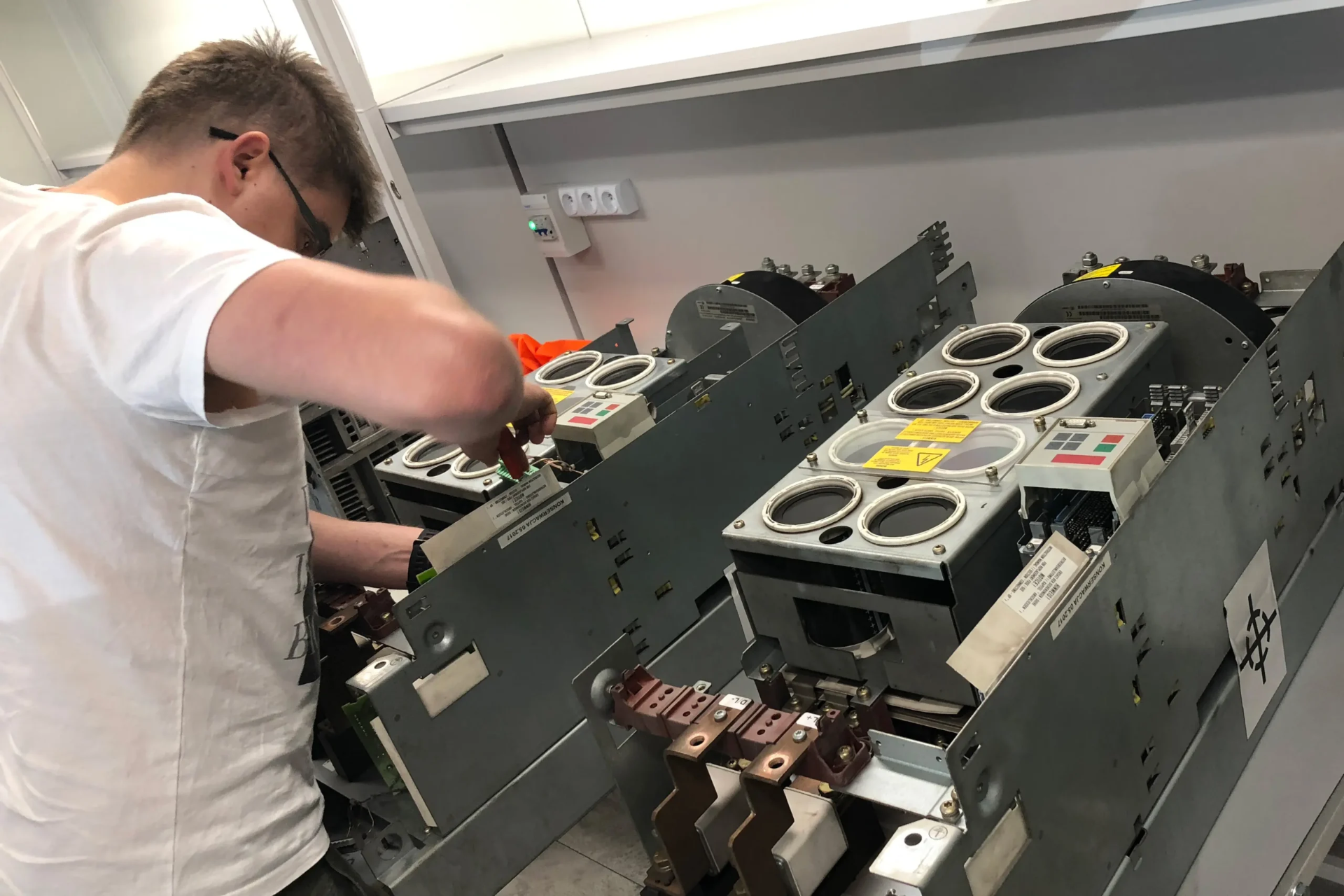
01 — Process
How does our process work?
Every engagement starts with a free diagnostic assessment or site survey — at the customer's site or at our facility near Wrocław.
01
Preparation and inspection
During the site survey we perform an initial diagnosis and plan spare parts, tools, and the team.
02
Planning
We build a Preventive Maintenance schedule tailored to the equipment's duty cycle.
03
Service work
We carry out the planned tasks — replacing worn components, lubrication, adjustments, and other scheduled activities.
04
Verification testing
Functional testing and electrical safety checks.
05
Report and alerts
We deliver documentation and predictive alerts on upcoming wear.
02 — Comparison
Electronics maintenance vs. mechanical maintenance
While electronics and mechanics are two distinct worlds, they share one priority — acting ahead of time. Preventive maintenance always outperforms costly, stressful repairs after a failure.
03 — Scope
Equipment scope covered by preventive maintenance
We support a broad portfolio of equipment — from IT infrastructure to aviation gear and test equipment.
- Flight simulators: projection systems, avionics, automation, hydraulics, HVAC
- Test and measurement equipment: testers, stations, measurement systems, sensors
- IT infrastructure: graphics cards, motherboards, servers, network devices
- Building infrastructure: all components of UPS and HVAC systems
- Vehicles: engines, drivetrains, power systems, electronics
- Workshop and test equipment: CNC machines, climate chambers, analyzers
- Batteries and power systems: capacity testing, cell balancing, replacement, upgrades
04 — Benefits
Benefits for the customer
Fewer failures — higher availability
Up to a 70% reduction in unplanned downtime. Equipment runs when it's needed.
Lower costs
Scheduled work is up to 50% cheaper than emergency repairs.
Full documentation
A complete report and calibration certificates for every job.
Flexibility
No need to ship equipment directly to foreign manufacturers.
05 — Standards
Delivery standards
- Schedules aligned with manufacturer requirements
- Predictive AI/ML models for key subsystems and equipment
- ISO 9001:2015 and AQAP 2110
- Team holding IPC and ESD certifications
06 — Data protection
Data protection
Diagnostic and job report data is processed in encrypted / dedicated databases on local networks or in European data centers compliant with ISO 27001. Access is granted only to personnel holding the appropriate industrial security clearance and authorized by the customer.
07 — Building systems
Building and critical infrastructure
HVAC, backup power, and building automation work in the background — but the safety of people, equipment, and mission continuity depend on them. We provide full service for these installations: from diagnostics and rapid repairs, through predictive maintenance, to upgrades compliant with current EU requirements.
- HVAC — air handling units, chilled water plants, rooftop units, and precision server room air conditioners
- Power and UPS — diesel generators, online UPS, MV/LV switchgear, grounding systems and PDUs
- Ventilation and filtration — CBRN filter walls, overpressure systems, fire dampers, heat recovery units
- Emergency systems — FM-200 / Novec 1230 gas suppression, fire detection, leak monitoring
- BMS automation — PLC controllers, SCADA, BACnet / Modbus networks, environmental sensors
- Power infrastructure — busbar systems, transformers, reactive power compensation, energy storage
- Auxiliary installations — access control for technical rooms, CCTV, emergency lighting
HVAC retrofit to new EU refrigerants
We design complete retrofit kits to convert older HVAC units to the new refrigerants required by EU regulations — replacing compressors and nozzles, then performing a certified leak test.
Live maintenance of critical server rooms
In facilities requiring uninterrupted operation, we use air-side bypasses and UPS/generator redundancy — service work is performed without interrupting critical IT systems.
FAQ
Frequently asked questions
How often should preventive maintenance be performed?
Typically every 6 or 12 months, but we tailor the schedule to usage intensity. In special cases (e.g., flight simulator visualization systems), preventive work is carried out even more frequently.
Do you offer remote monitoring between inspections?
Yes — we use solutions that send predictive alerts on upcoming wear. The system can be deployed in various ways: from analysis of visual data and user logs to an IoT sensor network.
How can equipment lifespan be extended?
Regular preventive inspections can extend full functionality by 10–15 years beyond the manufacturer's nominal expectation. Key factors are early planning of spare parts availability (logistics packages) and monitoring wear indicators.
How does predictive AI/ML/IoT analytics work in maintenance?
Our algorithms learn normal operating patterns from available sources (e.g., sensor data or logs) and then detect deviations indicating upcoming component wear. The AI platform processes data in real time and generates alerts up to several weeks in advance.
Can you service equipment without shutting down a critical server room?
Yes — as part of our live maintenance strategy, we use air-side bypasses, UPS/generator redundancy, and N+1 mode operation. This lets us perform maintenance and repairs without interrupting the customer's IT service continuity.
Let's talk
Let's plan a preventive maintenance program for your fleet
Want to reduce downtime and extend equipment lifespan? A&D Serwis will prepare an inspection schedule, predictive monitoring, and full documentation compliant with OEM, MoD, and NATO requirements.