Electronics Repair
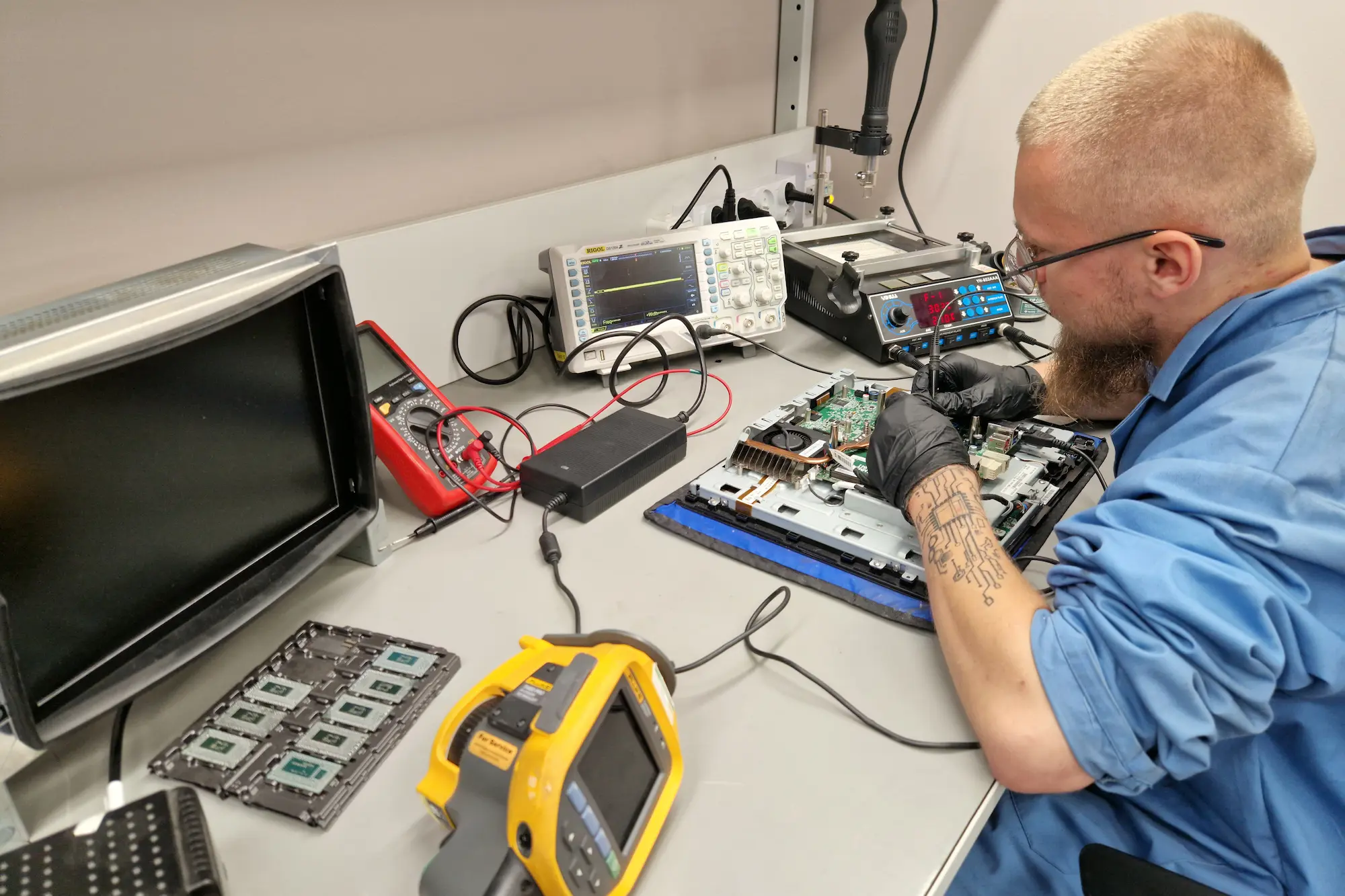
We take a systematic approach to keeping entire systems operational. Using advanced diagnostic technology, precision soldering techniques, and post-repair testing, we restore equipment to its original operating parameters.
01 — Process
What our process looks like
Every engagement starts with a free diagnostic assessment or site survey — at your facility or at our headquarters near Wrocław.
1.
Request intake
Online form or phone contact. Initial request registration and discussion of the service scope.
2.
Diagnostic process
Fault identification after equipment is shipped in, or an on-site survey for large systems (e.g. simulators).
3.
Equipment repair
Advanced component-level repair, re-engineering, and replacement of damaged parts.
4.
Functional testing
We verify operation under conditions close to real-world use, in accordance with MIL-STD-202.
5.
Shipping or installation
Equipment is returned to the Customer, or installed and commissioned on-site by our specialists.
6.
Report and warranty
Full documentation of work performed and a service warranty of up to 12 months.
02 — Why choose us
Component-level repair instead of costly replacement
01
We extend equipment lifecycle
Comprehensive repair instead of costly replacement of entire modules — we restore functionality to both modern and legacy electronic systems.
02
We reduce downtime
We also offer expedited repairs, with turnaround as fast as 24 hours in our lab, getting your equipment back into service quickly.
03
Safety and compliance
Certified processes fully compliant with defense-sector standards: IPC-7711/7721, MIL-STD-202, ESD ANSI/ESD S20.20, as well as ISO 9001:2015 and AQAP 2110.
04
Savings of up to 90%
Component-level repair costs on average 90% less than buying a new part and preserves the equipment's original specification.
03 — Comparison
Full module replacement vs. component-level repair
04 — Repair scope
What we repair
- Test & measurement equipment
- Vehicle and machinery electronics
- Computers and operator panels
- Projectors and visualization systems
- Servers and computer networks
- Drives and servomechanisms
- Electronic circuit boards
- Displays and interfaces
- Power supplies and communication modules
- Thermal imaging, night vision and optoelectronic systems
- Fire control system components
- Equipment used in flight simulators
- Electronic modules from weapon systems (e.g. torpedoes)
04b — Military equipment
Supported categories of military equipment
In addition to standard industrial electronics, we handle specialized categories of equipment covered by an MSWiA (Ministry of Interior) license, including discontinued equipment without OEM support.
- Radios, encryption devices and data transmission equipment
- Detonators and fuzes
- CBRE detectors (chemical, biological, radiological, explosive)
- Reconnaissance systems, sensors and short-range radars
- Vehicle onboard systems and artillery/aviation equipment
- Emergency generators, military power supplies and field UPS units
- Measurement and test equipment for military laboratories
- Control modules for flight simulators and trainers
- Legacy EOL equipment requiring retrofit
04c — Simulators
Flight simulator and trainer servicing
Simulators and trainers combine theoretical training with operational practice — crew safety and training effectiveness depend on their reliability. We service both entire platforms and individual subsystems, including equipment no longer supported by the manufacturer.
Visualization systems
- DLP/LCoS projectors and LED/laser light sources
- Spherical screens and edge-blending systems
- Geometric warping and GPU graphics servers
Cockpit and avionics
- Control panels and analog/digital indicators
- HOTAS systems and glass-cockpit modules
- Cockpit lighting and symbology generation
Motion systems
- Electric and hydraulic motion-platform actuators
- Motion controllers and G-seat/G-belt systems
- Encoders, torque and backlash calibration
Simulator IT infrastructure
- Simulation servers and CPU/GPU clusters
- PTP/NTP time-synchronization networks
- Routers, switches, redundancy, and simulator UPS units
Audio and communications
- Instructor intercoms and internal communication systems
- 3D spatial audio generation
- V/UHF radios and simulator radio bridges
Debriefing modules
- Flight-data recorders and playback stations
- After-action review (AAR) mission-analysis software
- Instructor stations and assessment systems
Life-extension upgrades
We replace discontinued DLP projectors with LED/laser sources offering higher durability and lower operating costs. We retrofit pilot cockpit panels and integrate newer displays into legacy simulators — extending their service life by years.
Firmware and software backup
We perform comprehensive firmware backups for individual modules as well as full backups of simulator software. We create physical disk copies and secure configurations, enabling system restoration after a failure within hours rather than weeks.
04d — Security equipment
Security and screening equipment servicing
We service security equipment protecting borders, airports, and critical infrastructure against chemical, radiological, and terrorist threats. Our capabilities restore functionality to both the latest systems and equipment no longer supported by the manufacturer.
- Mobile and stationary baggage X-ray scanners (RAPISCAN 600/900 series)
- Handheld backscatter X-ray scanners
- Walk-through metal detectors (WTMD) and personal screening systems
- Vehicle and undercarriage scanning systems (UVSS)
- EOD robots and ordnance disposal systems (TALON, PackBot)
- Chemical and radiological detectors (AP2C/AP4C series)
- Remote CBRN threat-analysis platforms
- Discontinued equipment without OEM support
Accredited calibration
We calibrate detectors, scanners, and measuring equipment in cooperation with accredited bodies, in accordance with applicable standards and manufacturer documentation. After each calibration we issue a certificate of conformity along with the next inspection schedule.
Clearance verification and NDA handling
Servicing security equipment requires access-clearance verification before a request is accepted. Technical documentation is exchanged under a signed NDA, and the scope of work is agreed individually with the operating unit.
04e — Server rooms and IT
Server infrastructure and computer systems
IT reliability underpins the operational readiness of military units, training centers, and strategic institutions. We service the entire server-room environment — from disk arrays and servers to network infrastructure and integrated systems.
- Disk arrays and backup systems — RAID rebuilds, mirroring configuration, data recovery
- Physical servers — diagnostics of motherboards, controllers, power supplies and cooling systems
- Networked computers — operator workstations, training terminals, control computers
- Switches, routers, firewalls, and watchdogs
- Integrated systems in simulators, command centers, and alarm systems
- Backplanes, RAID controllers, and I/O modules
Preventive maintenance of IT infrastructure
Server cleaning, fan replacement, thermal pad replacement, and RTC battery replacement. After every repair we perform load testing of components and a compatibility audit of the replacement parts used.
IoT monitoring and lifecycle management
We deploy IoT sensors reporting temperature, vibration, and power parameters in real time. We continuously monitor component obsolescence and flag risks related to parts being withdrawn from the market.
05 — Techniques and packages
Component-level repair — BGA, μBGA, QFN
We perform complex component-level electronics repair, including devices in BGA, μBGA, and QFN packages. We use a full range of soldering techniques — from reflow and reballing to manual and microscope-assisted micro-soldering. This allows us to safely replace components and restore connections even on multilayer boards.
Reflow
Soldering SMD and BGA components under a controlled thermal profile
Reballing
Restoring solder balls under BGA/μBGA packages
Micro-soldering
Manual, microscope-assisted work on the smallest components
Multilayer boards
Safe restoration of traces and vias
Data security
Full control over information
All data media are encrypted, and access to test stations is controlled. Selected repairs are carried out on a closed network with no internet access, eliminating the risk of classified information leaks.
Quality standards
We work in compliance with these standards
- IPC-7711/7721 Rework & Repair
- MIL-STD-202 Test Methods
- ESD ANSI/ESD S20.20
- ISO 9001:2015 & AQAP 2110
FAQ
Frequently asked questions
Do you repair discontinued circuit boards?
Yes — we offer complex electronics repair and can upgrade equipment by replacing individual electronic components or sourcing functional replacements. This lets customers keep equipment operational that manufacturers want to replace with costly new systems.
How long does a standard repair take?
Typically 10 business days for most faults; complex cases up to 30 days.
Can I get a test report after the repair?
You will receive a service report listing the repair work performed. If needed, we can also provide a test protocol, a list of replaced parts, and microscope, X-ray, or thermal imaging photographs.
Do you service simulators that are no longer supported by the manufacturer?
Yes — we use reverse engineering to design functional replacements for discontinued components. This applies to DLP projectors, cockpit panels, and older-generation electronic modules alike. This allows training centers to keep simulators in service even after official OEM support ends.
Is calibration of security equipment carried out by accredited bodies?
Yes — we calibrate CBRN detectors, X-ray scanners, and detection gates in cooperation with accredited laboratories, in accordance with applicable standards and manufacturer documentation. After each calibration we issue a certificate of conformity along with the next inspection date.
Can you remotely monitor server temperature and vibration?
Yes — we deploy IoT sensors reporting temperature, vibration, and power parameters in real time. Data is sent to an alarm dashboard, and deviation alerts let you react before a minor anomaly turns into a critical IT failure.
Let's talk
Let's repair your onboard electronics
Do you have a damaged avionics module or electronic component? A&D Serwis will perform full diagnostics, component-level repair, and functional testing with complete service documentation.